

"Tear Down This Wall"
The Perils of Demolishing the Wall between Church and State

“I contemplate with sovereign reverence that act of the whole American people which declared that their legislature should ‘make no law respecting an establishment of religion, or prohibiting the free exercise thereof,’ thus building a wall of separation between Church & State.”
-Thomas Jefferson, Letter to the Danbury Baptists, 1802
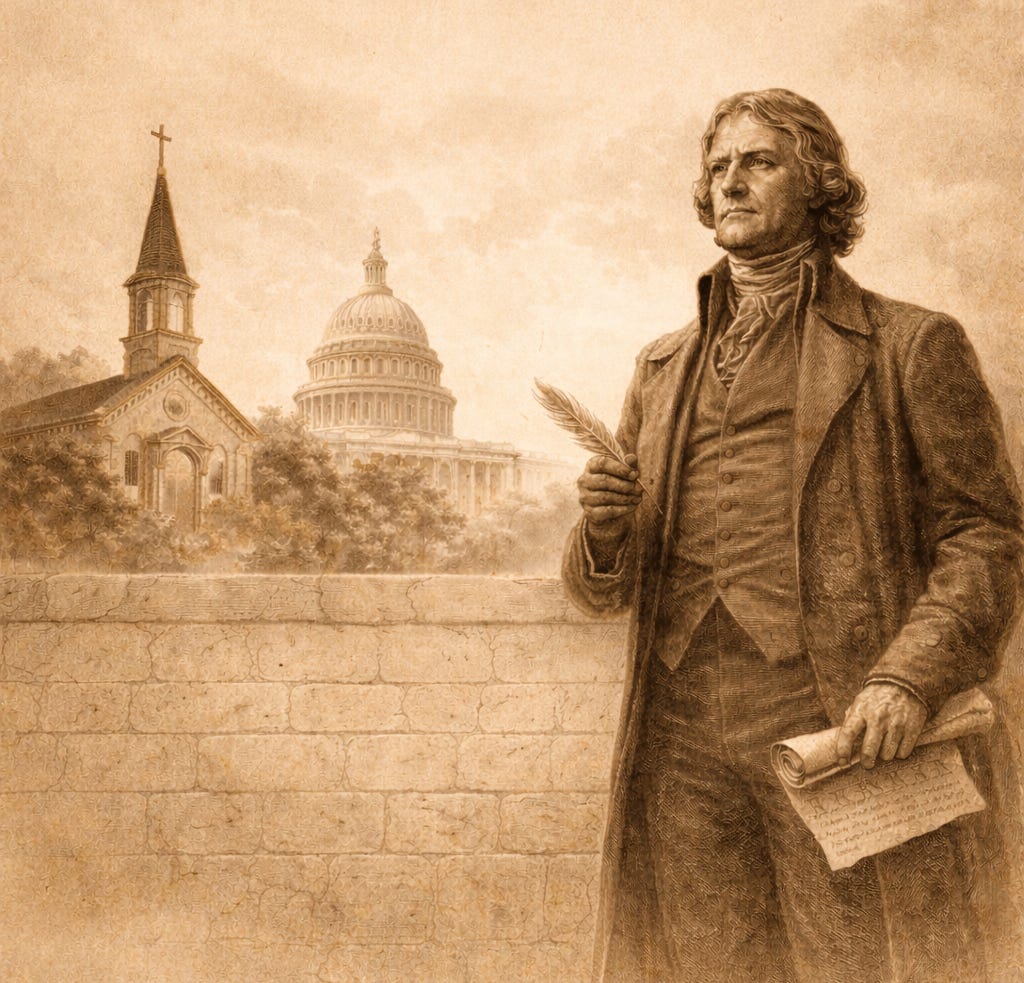
After Ronald Reagan, few figures are more lionized in the conservative canon than Thomas Jefferson. Our third president is presented as the fount from which the foundational conservative tenet of small government emerged. In the modern messianic Republican partyology, or pathology if you prefer, Jefferson assumes a Moses-like role whose agrarian Democratic-Republican Party inspired the later populist prophet Andrew Jackson. From there, the conservative continuum trundles along inevitably towards Reagan, who is now cast in the supporting role of John the Baptist, preparing the way for the miraculous political apotheosis of Donald Trump, the penthouse populist. Generations hence will likely regard Trump’s electoral success as only slightly less miraculous than the Bible’s tale of the virgin birth.
Reagan himself is largely to blame for the religious renaissance in the halls of American government. For it was he who married the elitist corporate right with the populist religious right. It was the actor turned president who introduced respectable Orange County country club Republicans — corporate hacks traditionally of the Nixon mold — with their voluminous checkbooks to the tawdry televangelists who prophesied national ruin unless America returned to its alleged Christian origins.
The Berlin Wall was not the only wall Reagan sought to tear down. His demolition of Jefferson’s “wall of separation” between Church and State was one of the most consequential acts of his presidency. The long-term negative outcomes of Reagan’s empowerment of the religious right are only outstripped by the disastrous fallout of Reaganomics, which gutted the middle class while instigating a wealth gap unseen since the Gilded Age. Both of these insidious seeds were watered by the 1990s “Republican Revolution” and the 2010s Tea Party movement to reach full blossom under the current regime.
This re-injection of religion into the public sphere was the essence of the Reagan era; this is what was meant by morning again in America. From the vantage point of 2026, rational reflection reveals that the 1980s were not even a false dawn, but the dusk that led to the midnight in which America is presently mired.
This is not a uniquely American phenomenon; world history is replete with warnings of the perils of the arranged marriage between temporal political power and organized religion. One does not need to leave the letter “I” to stumble upon two cautionary tales of the insidious relationship between religion and government. Furthermore, these are not tales mired in the murky past; the twentieth century provides two horrifying case studies nestled in the heart of Europe.
For seventy years, Irish political life was dominated by a ruling coalition between the nationalist conservative party, Fianna Fáil, and the Catholic Church hierarchy. This medieval cabal rigorously policed the public sphere via censorship and statutorily persecuted homosexuals and unwed mothers, while simultaneously covering up the systemic practice of clerical statutory rape of children under pastoral care (See Fintan O’Toole’s magisterial We Don’t Know Ourselves: A Personal History of Modern Ireland). Ultimately, the Irish theocracy strangled modernization as the Irish people were stuck in a no-man’s land between an agrarian past and an industrializing future — this says nothing of the collective trauma Catholicism branded into the Irish psyche and identity. The coalition eventually fractured, and by the 1990s, Ireland had transformed into the modern state that is now plundered by unrestrained corporate greed, much of it coming from America.
In Italy in the 1920s, the Vatican under Pius XI saw in Il Duce an opportunity to restore the Church’s temporal power that had been outlawed by the liberal secular order instituted by the nineteenth-century Italian unification movement, the Risorgimento. The relationship between the Fascists and the Church was not a reluctant Faustian bargain, but rather a coordinated, mutually beneficial program designed to augment the power of both church and state (Interested readers should see David Kertzer’s The Pope and Mussolini: A Secret History of Pius XI and the Rise of Fascism in Europe). The Church actively promoted Fascist policies from the pulpit while Mussolini enacted legislation preferable to the clergy, most significantly, the reintroduction of religious education in schools — sound familiar?
For all the lip service paid to the founders and the Constitution, the religious right’s entire worldview is contrary to America’s founding principles. Those religious dissenters who first settled in the wilderness of the New World sought escape from persecution by established religion. The Founders, steeped as they were in English and ancient history, knew that a government allied with theocracy has always been a civilizational cancer that has for millennia smothered human flourishing and societal growth at the cost of innumerable lives. That is why these later political dissenters constructed the first political regime in human history premised on the codification of personal liberties, foremost among them, the freedom of worship and thought. This tolerant and liberal worldview is anathema to the authoritarian impulses of organized religion that seek to control the very essence of the individual.
Thus, like Mussolini before him, Trump has found in the theocrats — specifically the Evangelicals Reagan legitimized — fellow crusaders in his authoritarianism. Under the marketable fig leaf of making America great again, the religious right is institutionalizing White Christian nationalism. Trump’s second act has been packed to the gills with performative religiosity— particularly Trump’s unconstitutional creation of the White House Faith Office, so much for the guiding principle of the non-establishment clause and the originalism of the Supreme Court’s conservative majority. Every day, ritualized hypocrisies from such gelatinous-spined individuals like Paula White and Karoline Leavitt punctuate this overarching theocratic creep.
Nowhere has the unconstitutional religiosity of Trump’s court been more strikingly evident than in Charlie Kirk’s martyrization. Kirk’s killing was a heinous crime. Period. Kirk was at least nominally committed to opening a dialogue across the political divide — albeit for calculated ends, as his engagement was driven primarily by a desire to churn out clickbait content of him “owning the libs.” Kirk’s interlocutors were often underprepared and deluded undergraduates parroting the latest academic truisms who were uniformly manipulated to serve Kirk’s digital saber-rattling in the ongoing culture war. Kirk’s rhetorical and intellectual punching down always struck me as carrying more than a mere whiff of the cowardice of the schoolyard bully.
However, Kirk’s actions are far less troubling than what is being done with his legacy. His memory has been co-opted into christening him another politicized saint in the martyrology of this messianic cause to combat alleged “militant secularism.” Secularism is not a militant force in American life today, nor has it ever been. Secularism has always been a restraining force rather than a destructive one; this is why Jefferson embraced it. This is why the Founders constructed our national edifice upon a foundation of separation between church and state. This is why conservatives have traditionally promoted such a separation, for they realize that in the alliance between religion and government are sown the seeds of tyranny.
The primary militant force in America today is the White Christian nationalism being peddled by podcast preachers and Bible-thumping bureaucrats who eternally outdo one another in their un-Christian behavior. Not only is their intolerance un-Christian, but their effort to define citizenship on the basis of ethnicity and religion is un-American. The current crusade being waged in tandem by the theocrats and the autocrats is the most significant internal threat to the survival of our Republic since the Civil War.
I urge those fallen Reagan conservatives who have morphed into cringing Trumpers to kindly pay Thomas Jefferson the courtesy of not invoking his name in your crusade for religiously reinforced authoritarianism — the man spent his life fighting such medieval forms of political organization. For that matter, I would suggest you desist from laying claim to George Washington as well. The Father of the Nation would not have pardoned the January 6th insurrectionists; he would have had them hanged for treason. Motivated as he was by the republican virtue of Ancient Rome, Washington likewise would have known how to handle our pumpkin-headed Caesar.
The religious right’s monopoly on laying claim to the Founders grows ever more fatuous as they daily prostitute themselves at the feet of the Don. In this, our 250th year, we must remind the world that they are not the heirs to the revolution; we, the people, who dissent from this religious-infused Trumpian tyranny, are.
Thread of Dissent is a reader-supported platform committed to bringing independent thinking to all. Your support of just $5 per month or $30 annually sustains my historical research, literary review, and cultural commentary. Your sponsorship ensures that all of my essays can remain accessible to all while also offsetting research and publication expenses. Upgrade today to keep the beacon of intellectual freedom burning brightly through the present autocratic twilight.